If you have been watching Fort Lauderdale’s commercial real estate market, you have probably noticed a clear shift: not every office building is competing on the same footing anymore. Some properties are still performing well, while others are facing a tougher question about whether office remains the best use. For owners, investors, and developers, understanding that split is key to making smarter decisions in this market. Let’s dive in.
Why office conversions are gaining traction
Fort Lauderdale’s office market is not in collapse, but it is changing. Recent brokerage reporting shows Broward office vacancy in the mid-to-high teens, depending on the source and methodology. At the same time, downtown asking rents remain strong, with Downtown Fort Lauderdale overall asking rents reaching $56.13 per square foot and Class A asking rents hitting $58.28.
That contrast matters. It suggests the pressure to convert is concentrated in older or less efficient office buildings, not across every submarket or building type. Colliers also reported more than 100,000 square feet of net move-outs from older, pre-2010 properties in late 2025, which reinforces the idea that obsolescence is driving many of these conversations.
Demand is stronger in alternative uses
Conversions only make sense when another use has a stronger outlook than office. In Fort Lauderdale, that demand story is real. Broward County’s stabilized multifamily occupancy reached 93.5% in early 2026, and Central Fort Lauderdale stood out at 94.4% stabilized occupancy with average effective rent of $3,049 per unit.
Hospitality is also showing strength. Visit Lauderdale reported March 2026 hotel occupancy at 85%, with hotel demand up 9% year over year. The expanded convention center activity and the opening of the new 801-room Omni hotel add more evidence that lodging demand is not just a short-term bump.
For investors, that creates a practical underwriting question: if an aging office property is losing competitiveness, could apartments, hotel rooms, or a mixed-use program produce a stronger income profile?
Fort Lauderdale’s planning framework supports reuse
One reason this topic matters more in Fort Lauderdale than in some markets is the city’s planning direction. The city’s Downtown Master Plan already frames downtown as a mixed-use urban center where housing, office, shopping, and entertainment can coexist. That kind of policy foundation makes reuse and repositioning easier to support from a land use standpoint.
The city is also working on updated mixed-use rules for major corridors. According to Fort Lauderdale, proposed amendments include form-based standards such as neighborhood transitions, maximum streetwall length, minimum podium stepbacks, and floorplate size limitations. The city has stated this effort is moving forward in anticipation of additional residential applications along key corridors.
In simple terms, Fort Lauderdale is not just allowing change. It is actively shaping where and how that change happens.
Parking reductions can improve feasibility
Parking is often one of the biggest obstacles in office conversion projects. Fort Lauderdale stands out because its Transit Core, Downtown Core, and Near Downtown standards reduce that burden in ways that can materially help a deal pencil.
In the Downtown Core and Near Downtown areas, residential parking is exempt. Non-residential uses are exempt below 2,500 square feet, and above that threshold required parking is reduced to 50% of the standard table. For adaptive reuse of certain historic properties, the city allows even more flexibility, including one off-street space per dwelling unit in some cases and reduced or exempt parking for qualifying commercial reuse.
That matters because many older office buildings were not designed to support modern parking ratios for a full redevelopment. If a project can rely on walkability, public garages, shared-use parking patterns, and transit access, the numbers may work far better than they would in a more auto-dependent setting.
Not every office building is a good candidate
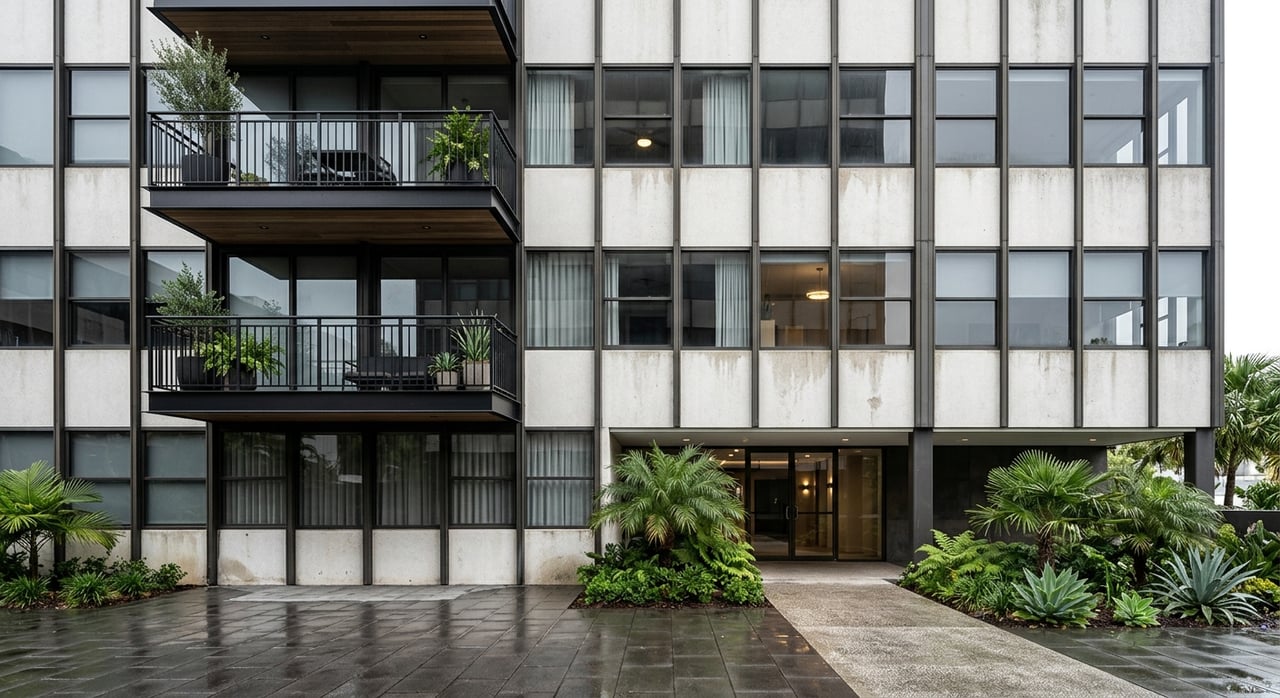
A soft leasing story alone does not make a building convertible. Physical form is often the deciding factor. Buildings with manageable floor plates, workable window lines, adaptable cores, and realistic paths for mechanical, electrical, plumbing, and life-safety upgrades are generally better candidates.
On the other hand, deep floor plates, sealed facades, limited daylight, and hard-to-rework cores can make a conversion far more expensive. Those features do not automatically end a project, but they can reduce unit efficiency, raise construction costs, and narrow lender appetite.
For Fort Lauderdale assets, this is where disciplined screening matters most. The best conversion opportunities are usually not just underperforming offices. They are underperforming offices with a physical layout that can support a new use without excessive structural intervention.
Floodplain rules can change the math
In Fort Lauderdale, resilience is part of the investment analysis. The city notes that work in Special Flood Hazard Areas requires a permit, and a large share of the city’s residents live in or near flood hazard areas. For older office buildings near the waterfront, canals, or other flood-prone locations, that can become a major cost factor.
The city also states that if the cost of reconstructing, rehabilitating, expanding, or otherwise improving a flood-damaged building reaches or exceeds 50% of the building’s market value, the National Flood Insurance Program requires the structure to meet the same construction and code requirements as a new building. For a value-add investor, that means flood compliance can materially affect whether it makes more sense to hold, renovate, convert, or sell.
This is one reason local due diligence matters so much in Fort Lauderdale. A promising basis on paper can look very different once resilience upgrades and code triggers are fully priced in.
Historic properties have added tools
Historic office or commercial assets may have another path. Fort Lauderdale offers incentives for designated historic commercial resources, including a 50% property tax reduction for qualifying commercial or nonprofit use. The Historic Preservation Board may also grant waivers for certain setbacks or distance separation requirements to support adaptive reuse.
Those incentives can improve feasibility, but they do not remove core entitlement limits. The board cannot waive density, floor area ratio, or height standards. In practice, that means historic designation can help a project work better, but it does not turn every challenging property into a viable conversion.
The likely winners: hold, convert, or mix uses
The Fort Lauderdale market increasingly points to three strategic paths.
Hold or renovate competitive offices
If a building is well-located downtown, already competitive, and capable of supporting modernization, keeping it as office may still be the right move. Strong downtown rent levels and relatively lower Class A vacancy suggest that top-tier office buildings still have room to perform.
For these properties, the opportunity may be selective upgrades rather than a wholesale change of use. Owners who can improve tenant experience, update systems, or reposition common areas may be able to defend office value.
Convert obsolete assets
Older, pre-2010 buildings with weak leasing, functional obsolescence, or heavy capital needs are more likely to face conversion pressure. When office income no longer justifies the renovation required to stay competitive, a new use becomes a highest-and-best-use question.
In Fort Lauderdale, that often means studying residential or hospitality demand first. With healthy multifamily occupancy and strong hotel performance, those uses may offer a more compelling long-term story for the right asset.
Rebalance through mixed use
In many cases, the answer is not a full one-for-one conversion. It is a mixed-use repositioning. Fort Lauderdale already provides clear examples of this pattern, including One Financial Plaza Phase III, a 300-unit mixed-use residential project designed to wrap an existing office tower and parking garage, and the FAT Village project, which combines multifamily, office, retail, and parking near Brightline.
That is an important signal for investors and developers. The city’s evolution appears less focused on eliminating office entirely and more focused on creating denser, more complete urban districts where office becomes one component of a broader mixed-use environment.
What investors should evaluate first
Before pursuing an office conversion in Fort Lauderdale, it helps to ask a short list of practical questions:
- Can the building’s footprint support efficient apartments, hotel keys, or mixed-use layouts?
- Is the property in an area where mixed use, adaptive reuse, or transit-oriented density is already supported?
- How much parking can be reduced, shared, or exempted?
- What floodplain, code, or resilience upgrades will be required?
- Are there historic incentives that could improve the capital stack?
- Does the projected post-conversion income outperform a realistic office hold scenario?
These are not abstract planning questions. They are the core underwriting issues that determine whether a Fort Lauderdale conversion is compelling or simply expensive.
What this means for Fort Lauderdale
Office conversions are reshaping Fort Lauderdale, but not because the entire office market is failing. The bigger story is selective repricing. Newer, well-located office assets can still compete, while older buildings are increasingly being judged against stronger alternatives such as multifamily, hospitality, and mixed-use redevelopment.
Fort Lauderdale’s zoning direction, parking flexibility, adaptive reuse tools, and floodplain requirements are all pushing the market toward a more nuanced outcome. The city is becoming more open to turning obsolete office properties into part of a denser and more flexible urban fabric, especially in locations where transit access and mixed-use planning already support that shift.
For owners and investors, the takeaway is clear: the opportunity is not in assuming every office building should convert. It is in identifying which assets still deserve office capital, which ones support a new use, and which ones are best repositioned as part of a broader mixed-use strategy.
If you are evaluating an office asset, redevelopment site, or repositioning opportunity in South Florida, Florida Commercial Group brings underwriting discipline, market perspective, and investor-focused advisory to help you assess the next move with clarity.
FAQs
What is driving office conversions in Fort Lauderdale?
- Office conversions in Fort Lauderdale are largely being driven by weaker performance in older and less efficient office buildings, combined with stronger demand for multifamily, hospitality, and mixed-use development in the right locations.
Are all Fort Lauderdale office buildings good conversion candidates?
- No. Buildings with manageable floor plates, workable window lines, adaptable cores, and feasible system upgrades tend to be stronger candidates than buildings with deep floor plates, limited daylight, or expensive structural constraints.
How do parking rules affect Fort Lauderdale office conversions?
- Fort Lauderdale’s Downtown Core, Near Downtown, and certain adaptive reuse standards can reduce or exempt parking requirements, which may significantly improve the feasibility of residential, commercial, or mixed-use conversions.
Why do floodplain rules matter for Fort Lauderdale redevelopment?
- Floodplain rules matter because permits are required in Special Flood Hazard Areas, and substantial improvements to flood-damaged buildings can trigger new-building code requirements, which may add major costs to a conversion or renovation.
Is mixed-use redevelopment more common than full office conversion in Fort Lauderdale?
- In many cases, yes. Fort Lauderdale’s planning direction and recent projects suggest that mixed-use redevelopment is often a practical strategy when part of an existing office asset still holds value or when a full change of use is less efficient.