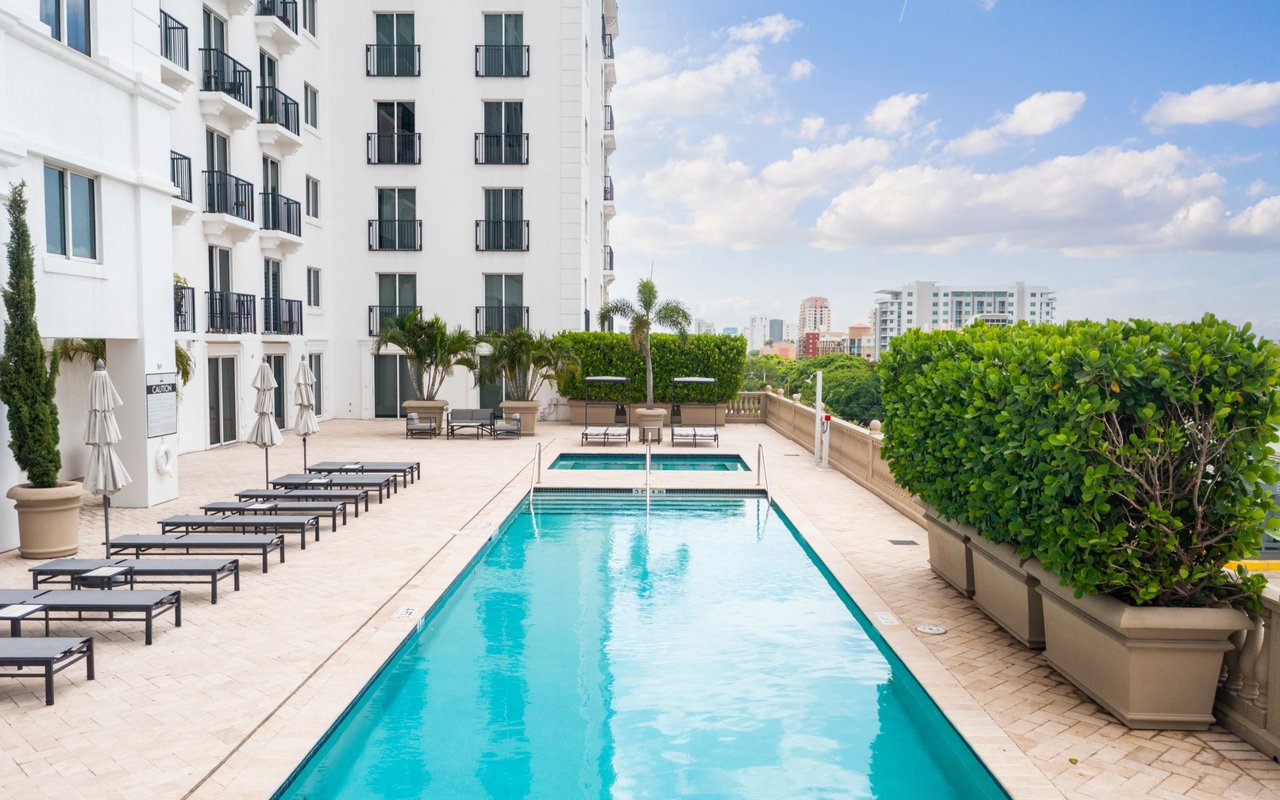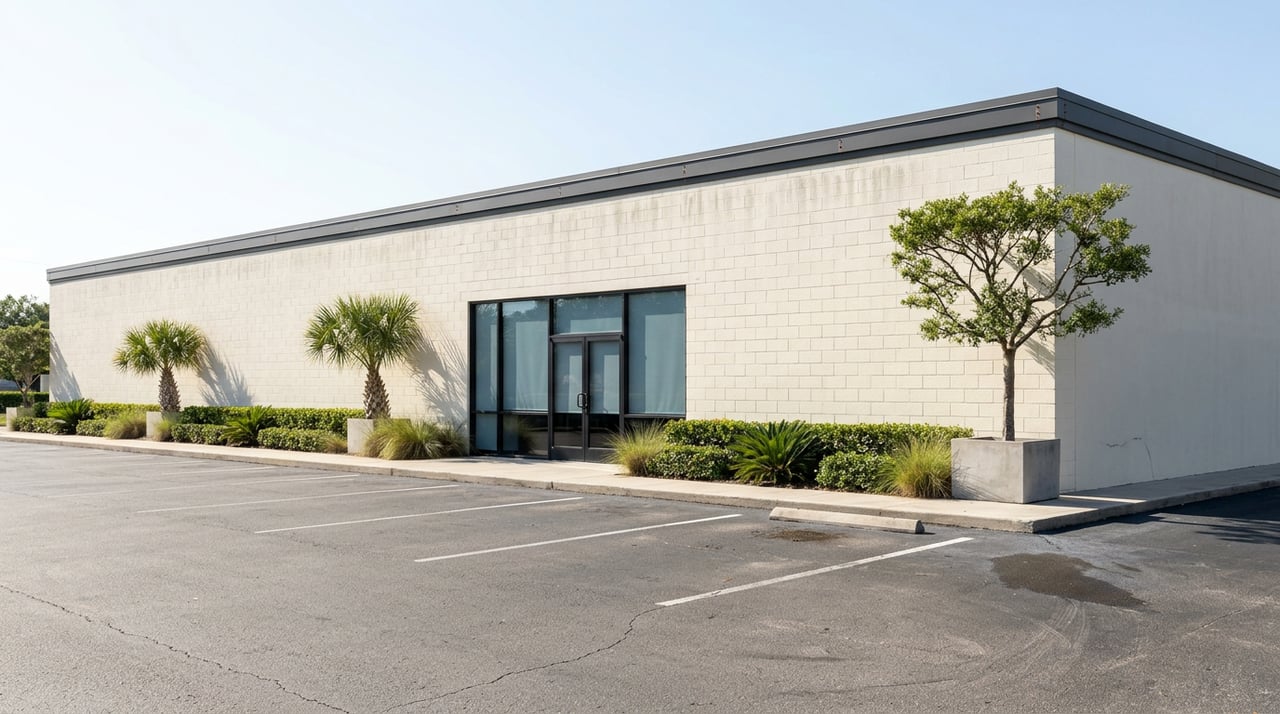
On May 14, 2026, three separate development teams sat before the same West Palm Beach Plans and Plats Review Committee agenda. Pebb Capital walked staff through a 350-unit residential plan for 11.6 acres on South Dixie Highway that the firm had bought in 2024 for $53 million. Jeff Greene's team presented a 25-story, 366-unit mass timber tower on Datura Street built around two preserved facades of a 111-year-old fire station. A third group described a 15-story, 310-unit project on West Railroad Avenue near the Brightline platform, including 84 micro-units. Three sites. Three product types. One statute doing most of the work in the background.
For owners of commercial parcels in West Palm Beach, the takeaway from that morning is not that apartments are coming. It is that the buyer pool for their land has quietly changed, and the underwriting most sellers are using has not caught up.
The thesis, stated plainly
Commercial-zoned land in West Palm Beach is no longer priced on its in-place income. It is increasingly priced on its residual value as multifamily under Florida's Live Local Act. Owners still modeling Class B office buildings, aging strip retail, and small industrial sites on cap rate alone are anchoring to the wrong number when a sale conversation begins.
What the statute actually does to a commercial parcel
Live Local allows qualifying multifamily to be built on land zoned commercial, industrial, or mixed-use without rezoning or a comprehensive plan amendment, with administrative approval rather than discretionary hearings. Subsequent amendments in 2024 and 2025 preempted local floor area ratio limits and raised the mandatory parking reduction from 10 percent to 15 percent. In March 2026, the Legislature passed House Bill 1389, which further narrows local discretion and, if signed, takes effect July 1, 2026.
Translate that from statute into deal terms. A developer looking at a strip retail center on an arterial no longer needs to price in twelve to twenty-four months of political risk to secure entitlements. They price in an administrative approval window and a workforce housing set-aside, usually 40 percent of units. That risk compression is what shows up in the offer.
Reading the May docket as a pricing signal
The three May 14 filings each tell you something different about how the mechanism is being used.
Pebb Capital, 2715 S. Dixie Highway. The 11.6-acre site currently holds five buildings totaling roughly 286,090 square feet, including the offices leased by the Palm Beach Post. Pebb paid about $4.57 million per acre in 2024. That is not a number a strip-office income model produces. It is a number a residual land value model produces once you assume 350 units and a Live Local entitlement path.
Jeff Greene, 120 South Dixie / 321 to 333 Datura. Greene is designating 148 of the 366 units, or 40 percent, as workforce housing to qualify for the administrative approval path. The site is a fire station and low-rise commercial assemblage in the CBD. Under prior entitlement rules, the assemblage would have required a full rezoning and design review process. Under Live Local, it requires staff sign-off on qualifying criteria.
411 West Railroad Avenue. A 15-story, 310-unit project on land immediately adjacent to Brightline. That parcel's highest and best use twelve months ago was arguably transit-adjacent office or hotel. Today it is priced as a mid-rise residential site with 84 micro-units in the unit mix.
The mechanism is not that the buildings changed. It is that the entitlement risk on the land changed, and the residual land value moved with it.
Why cap rate math understates disposition value now
Consider a family owner of a 40,000-square-foot Class B office building on an arterial corridor in West Palm Beach. Rent roll produces, say, $1.4 million in net operating income. Palm Beach County office cap rates are running roughly 6.0 to 7.25 percent in 2026, according to broker surveys aggregated by CBRE and CoStar. At a 6.5 percent cap, the building is worth about $21.5 million as an income asset.
A residential developer looking at the same parcel is not solving for that number. They are solving for how many units the site holds under Live Local's preemption of local FAR, how many parking stalls the parking reduction lets them strip out, and what the workforce set-aside costs against the market-rate units. On the right corridor, the residual land value the developer can pay often exceeds the income-approach value, sometimes materially. That gap is the disposition premium a seller captures if the marketing process actually reaches the residential buyer pool.
The corollary is uncomfortable. If the marketing process only reaches income buyers, the seller never sees the residential bid. The building trades at 6.5 cap, and the residual value stays with the buyer.
Where this is showing up first in West Palm Beach
Three corridors are absorbing most of the activity worth watching.
The South Dixie Highway corridor south of downtown is the clearest case. Pebb's $53 million assemblage sits there, and the corridor's older commercial stock, including auto uses, small offices, and single-tenant retail, maps cleanly onto Live Local's target zoning categories.
Datura Street and the western CBD edge is where infill Live Local plays are surfacing. Greene's site is one. The pattern is smaller, older commercial parcels being consolidated for towers that would not have penciled under a discretionary approval path.
The North Railroad Avenue and Brightline-adjacent frontage is a third. The NORA District's $1 billion, 40-acre redevelopment sits at the north end of this corridor. The 411 West Railroad filing shows that the Live Local path is being used to fill in the surrounding blocks with denser residential product than prior zoning contemplated.
Two adjacent variables to keep in the model. First, the Flagler Drive realignment advanced by Related Ross and the City, which would shift the roadway inland and replace a six-block waterfront stretch with a park, is a political decision that will reprice everything within sightlines of it. Second, the county-wide office pipeline of roughly 1.6 million square feet under construction, ranking the metro fifth nationally per Yardi Matrix data, means Class B office owners are watching a widening quality gap. That gap is precisely what makes their land more valuable as a residential residual than as a repositioning bet.
The July 1 timing question
HB 1389 is the piece most sellers are underweighting. The 2026 amendments further limit local discretion over qualifying developments and expand the statute's applicability. If signed, the effective date is July 1, 2026.
For an owner considering a sale, the calendar matters in two directions. A parcel marketed before the effective date trades against the current entitlement math, which developers can already model with confidence. A parcel marketed after the effective date trades against the expanded math, which may pull in sites that today's version of the statute leaves ambiguous. Both windows can produce a competitive process. What does not produce a competitive process is going to market without knowing which window applies to your parcel, or without preparing the entitlement narrative a residential buyer needs to underwrite.
The legal environment is also worth pricing in. The statute is being tested in court. A Broward County ruling favored the City of Hollywood in one dispute, though the developer is appealing, and the Florida Attorney General intervened in support of a Live Local application tied to the proposed Bal Harbour Shops redevelopment. Municipal setback and design-standard ordinances have been used in the first wave of projects to blunt the statute's effect. A sophisticated developer prices that friction in. A first-time seller often does not know to ask about it.
What owners should stress-test before going to market
- Whether your parcel's current zoning designation qualifies under the statute as amended in 2024, 2025, and pending HB 1389.
- Whether the site's dimensions, existing FAR, and setbacks support a residential program a developer would actually pursue, not merely one the statute permits.
- What the workforce set-aside math does to residual land value at your parcel's rent comps.
- Whether local ordinances have added setback, height transition, or design standards that reduce the statute's practical benefit on your block.
- Which buyer pool your broker's process is actually reaching. If the marketing plan is income-buyer only, the residential bid never surfaces.
FAQ
Does Live Local apply to sites already leased to a going commercial concern? The statute governs zoning and entitlement, not tenancy. Existing leases run with the land. A developer's underwriting will include buyout, holdover, or delivery-vacant assumptions, and that shows up in the offer price and closing timeline.
Is this only a downtown story? No. The statute reaches commercial, industrial, and mixed-use zoned land across the city. Suburban arterial retail and small industrial parcels can qualify, though the residual math is corridor-specific.
What about a 1031 exchange out of the sale? A commercial sale into a residential-developer buyer still qualifies for 1031 treatment on the sale side, with the usual identification and closing timelines. The relevant question for exchange planning is whether the disposition premium is large enough to change what replacement property the proceeds can support.
If you own commercial land in West Palm Beach and want to understand what your parcel is actually worth to the buyer pool that has entered the market in the last twenty-four months, Florida Commercial Group can walk through the entitlement math and marketing strategy alongside you. Discuss your asset strategy — connect with our commercial advisory team.