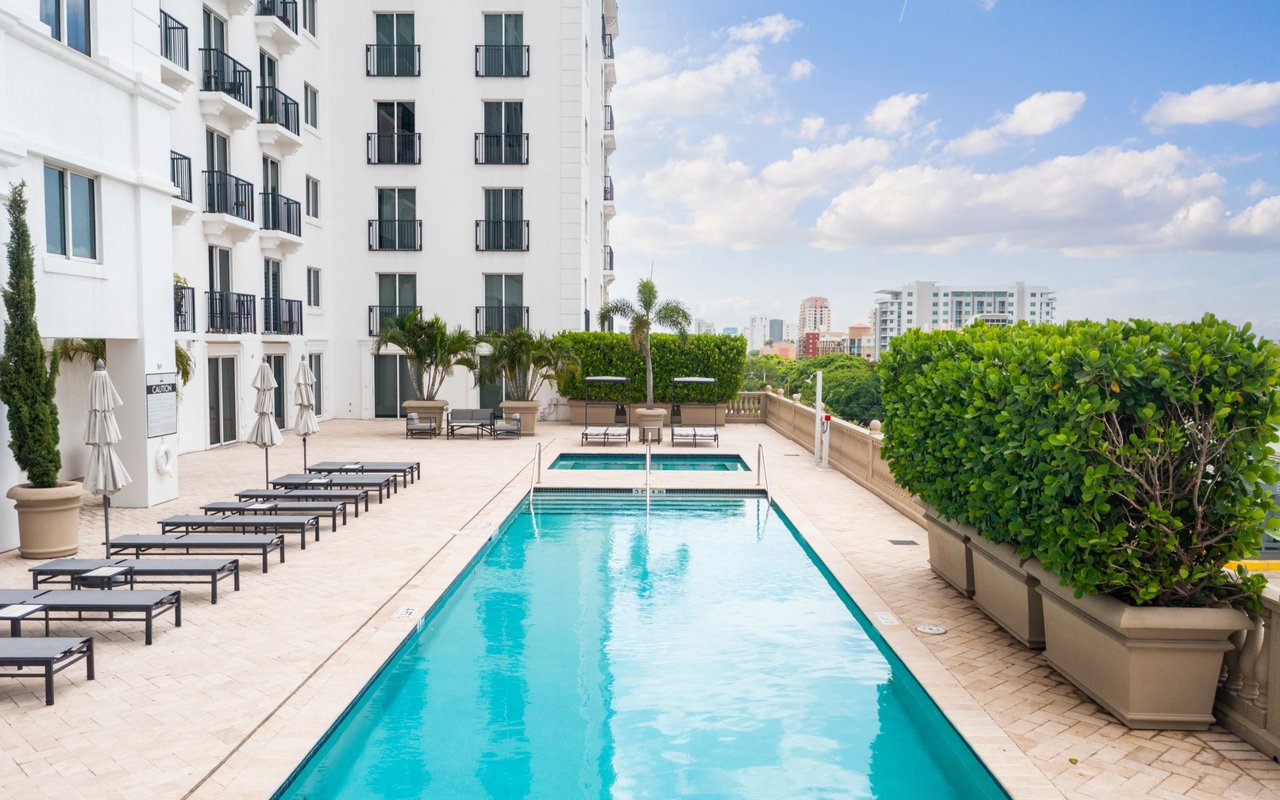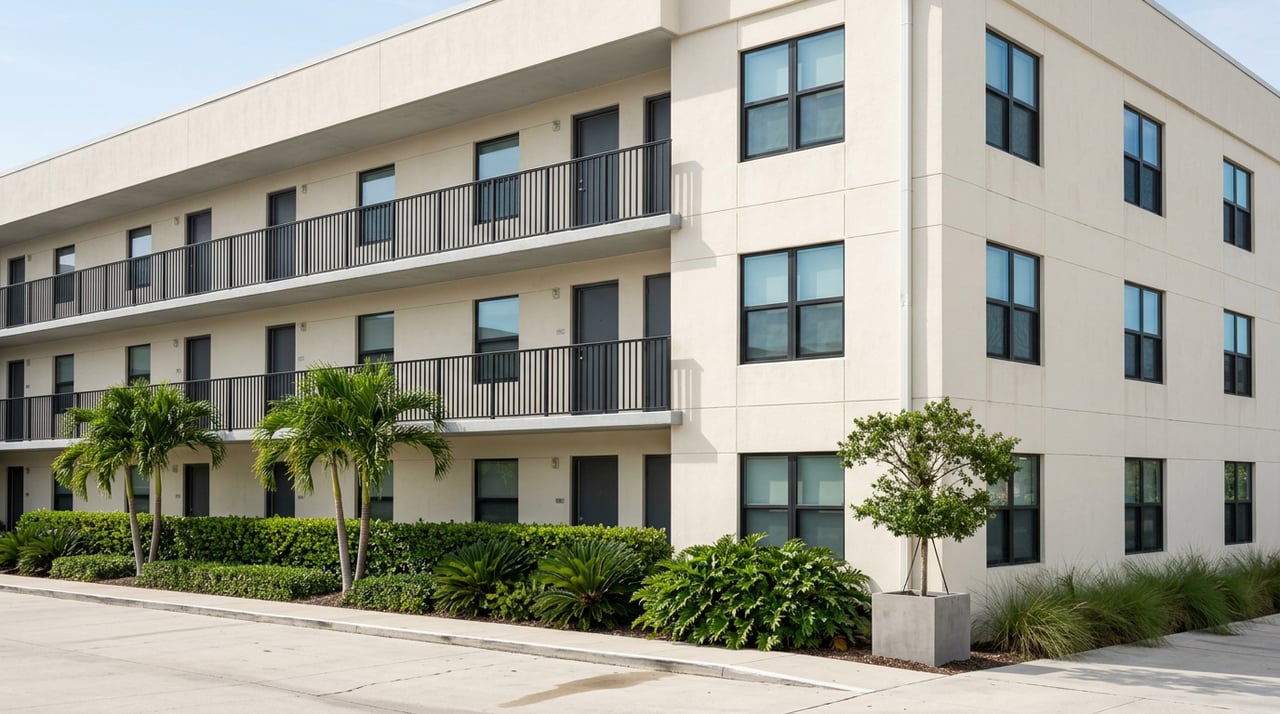
The headline number for Broward multifamily right now is a 5.6% average cap rate. It is also the least useful number an investor could underwrite against. Fort Lauderdale has 8,760 units under construction, mostly Class A luxury near I-95 and Las Olas Boulevard, driving the vacancy up to 7.6%. Annual multifamily sales total $1.8 billion, with multiple $100M+ trades. Cap rates rose to 5.6% as rising interest rates and softening fundamentals pressure pricing, particularly for higher-vacancy properties. Averaging trophy Class A with workforce garden product produces a number that describes nothing you can actually buy. The market underneath it is two markets, moving in opposite directions, and the trades that closed over the last four quarters make the split explicit.
The bifurcation the average is hiding
Fort Lauderdale rent growth cooled to roughly 0.1% on a trailing basis, but that flat line is the sum of a Class A giveback and a Class B/C expansion. Rent growth slowed to 0.1% as a large luxury supply wave expands vacancies and pushes concessions higher. Despite this cooldown, rents remain more than 25% above early-2021 levels and over 34% above the U.S. average, while demand has rebounded, averaging over 1,000 units of absorption per quarter since late 2023. Vacancy has risen to 7.6% amid one of Florida's largest pipelines, though it remains tighter than most major metros, with pressure concentrated in Class A units. Lower-rent submarkets, including Oakland Park/Lauderhill, Hollywood/Dania Beach, and Pompano Beach/Deerfield Beach, are posting some of the strongest annual rent gains as renters shift toward more cost-effective geographies. These areas are benefiting from heightened demand for attainable housing amid elevated metro-wide rents.
The pattern is national, not local. Rent performance varies considerably by building quality. The 1 & 2 Star segment posts the strongest growth at 1.1%, benefiting from limited new supply and a captive renter base with fewer alternatives. The 3 Star segment is growing at a modest 0.3%, while the 4 & 5 Star segment, where roughly 85% of recent completions are concentrated, registers only 0.2% growth. This quality-tier divergence is a defining characteristic of the current cycle: the premium segment, which drove outsized returns from 2015 through 2022, is now bearing the full weight of the supply correction. Fort Lauderdale is a concentrated version of that story, because the delivery pipeline is sitting on top of a narrow geographic band.
| Segment | 2026 Signal | Implication for Underwriting |
|---|---|---|
| Class A, Las Olas / I-95 corridor | Vacancy pressure, rising concessions, rent growth near flat | Trend rents down, extend lease-up, model concession burn |
| Class B, inland Broward | Strongest annual rent gains in the metro | Trend rents up modestly, tighter vacancy assumption |
| 1 & 2 Star (workforce) | ~1.1% national rent growth, captive tenant base | Most defensible NOI, lowest cap-rate compression risk |
| Pipeline exposure | 8,760 units under construction, mostly Class A | Comp risk is submarket-specific, not metro-wide |
An investor looking at the 5.6% average and assuming the whole metro trades there will overpay for the Class A tower and underbid the workforce asset. Both mistakes are common right now.
Insurance is the actual cap-rate story
The reason the split has widened is not rent. It is the expense line. Rising property insurance premiums, particularly in coastal and disaster-prone Sun Belt markets, are emerging as a material headwind to operating margins. Annual premium increases of 15% to 30% have become common in Florida, Texas, and Louisiana, compressing net operating income and potentially impairing debt service coverage ratios for leveraged assets.
Fannie Mae states that "much of the growth in multifamily property values over the past two decades has stemmed from price appreciation, rather than from net operating income increasing." This trend has been slowing since 2022 due to net operating income declining during the last two years. This has been the result of increased operating expenses, primarily insurance, taxes and the cost of labor for maintenance.
A 20% jump in insurance premiums on a Broward Class A tower where rents grew 0.1% is not a bad quarter. It is a permanent 30 to 60 basis points off the cap rate a buyer will pay next cycle, because the market is now underwriting that expense trajectory into every offer.
That is why cap rates expanded even as debt eased. The Federal Reserve cut rates from 5.25% down to approximately 3.5% to 3.75% through 2024 and 2025. LA multifamily cap rates expanded anyway. Local regulatory risk, rising insurance costs, and flat rent growth absorbed the benefit before it reached buyers' return requirements. The same dynamic is playing out in Broward. A rate cut does not close the pricing gap if the expense stack is still moving against the seller.
The consensus that yields will compress in 2026 assumes that expense normalization arrives on schedule. Multifamily cap rates have held steady at 5.7% for seven quarters, the longest such streak in 25 years. But that trend may be ending. Analysts expect cap rates to decline gradually in 2026 as several temporary market frictions begin to ease. According to First American's Potential Cap Rate (PCR) model, the "true" cap rate supported by market fundamentals sits at 5.1%, creating a 60-basis-point gap with the observed rate. A 60-basis-point compression is meaningful, but in Broward it will not arrive evenly. Assets with credible insurance renewals and stabilized reserves will re-rate first. Assets that have to prove their expense stack in every offering memo will not.
What the $100M+ trades actually tell you
The largest Broward transactions of the last cycle are worth reading as a group, not individually. Fort Lauderdale's multifamily investment market recorded $554M in sales just this quarter and $1.8B in annual sales, in line with pre-pandemic levels, though activity has slowed from recent highs. Several transactions exceeded $100 million, including PonteGadea's $165 million purchase of the 259-unit Veneto Las Olas, TA Realty's $118 million acquisition of Bell Pembroke Pines, and Journey Capital's $102 million purchase of The Rise Central at Plantation Walk. Newly built 4 & 5 Star properties, like The Ellsworth, continue to command premiums, while older or higher-vacancy assets trade at discounts.
Three observations sit inside that list:
- The trophy trade cleared, but the buyer was a family office with a permanent capital mandate. PonteGadea's Veneto Las Olas acquisition is a hold-forever thesis, not a yield trade. Institutional yield buyers were not the ones underwriting the coastal Class A number.
- The two other nine-figure trades landed inland. Pembroke Pines and Plantation are not part of the Las Olas concession war. They are where absorption has been running and where insurance carriers still write clean renewals.
- The Ellsworth premium is a signal about vintage, not location. New-construction NOI comes with a clean insurance file, warranty coverage on structural components, and no deferred capex overhang. That combination is what is actually being priced, not the address.
For a private investor or 1031 buyer, the read is straightforward. The coastal Class A story is being played by capital that does not need cap-rate math to work. Everyone else is buying inland Broward or new-vintage product, and the pricing gap between those two pools is where the deal flow is.
The transaction friction that catches sellers late
Two frictions are surfacing consistently in Broward multifamily closings right now, and both belong in a seller's pre-market prep rather than in a buyer's diligence surprise.
The first is insurance binder timing. Carriers are pricing renewals off the most recent 4-point and wind mitigation reports, not off the offering memo's expense grid. A seller who last shopped coverage 18 months ago is often quoting a premium the buyer's carrier will not match, which shows up as a retrade after best-and-final. Pulling a fresh insurance quote before going to market removes the largest single source of price erosion in the current environment.
The second is the debt assumption question. As lenders resolve troubled loans and regain balance sheet capacity, more capital will return to the multifamily market. Improved debt availability should help boost deal activity and support lower cap rates. Agency debt originated in 2020 through 2022 carries coupons that are meaningfully below today's market. Assumable loans on stabilized Broward assets are trading at price premiums that a straight cap-rate comparison will miss. A seller who does not surface the assumability of existing debt in the marketing package is leaving basis points on the table.
Both frictions reward the seller who prepares the underwriting file the way a buyer's investment committee will actually receive it. That is a marketing decision, not a pricing decision, and it is where advisory work compounds.
The thesis in one line
Fort Lauderdale is not a 5.6% cap-rate market. It is a bifurcated market where the coastal Class A tower and the inland workforce garden are trading on different fundamentals, priced by different buyer pools, and moving in opposite directions on NOI. The 5.6% average is what happens when you add them together and divide by two. It is not an offer you can send.
FAQ
Why did Broward cap rates expand while the Fed was cutting? Expense inflation absorbed the rate relief before it reached buyer return requirements. Insurance premium increases of 15% to 30% annually in Florida, combined with flat rent growth in the Class A segment, kept underwritten NOI flat or declining even as debt got cheaper.
Which Broward submarkets are showing the strongest workforce rent growth? Oakland Park/Lauderhill, Hollywood/Dania Beach, and Pompano Beach/Deerfield Beach have posted the metro's strongest annual rent gains as tenants shift toward more attainable price points. Vacancy pressure is concentrated in Class A near Las Olas and along the I-95 delivery corridor.
Is the Fort Lauderdale pipeline going to compress further? The national forecast is that absorption overtakes deliveries in oversupplied Sun Belt markets by the second half of 2026, which sets up firmer rent growth entering 2027. Broward's pipeline is heavily front-loaded in Class A, so the recovery will show up first in workforce and stabilized 3 Star product, not in the trophy tier.
If you are underwriting a Broward multifamily acquisition, disposition, or 1031 exchange and want a pricing view that reflects the submarket you are actually in rather than the metro average, Florida Commercial Group can walk through the trade comps, insurance assumptions, and buyer pool that apply to your asset. Discuss your asset strategy — connect with our commercial advisory team.